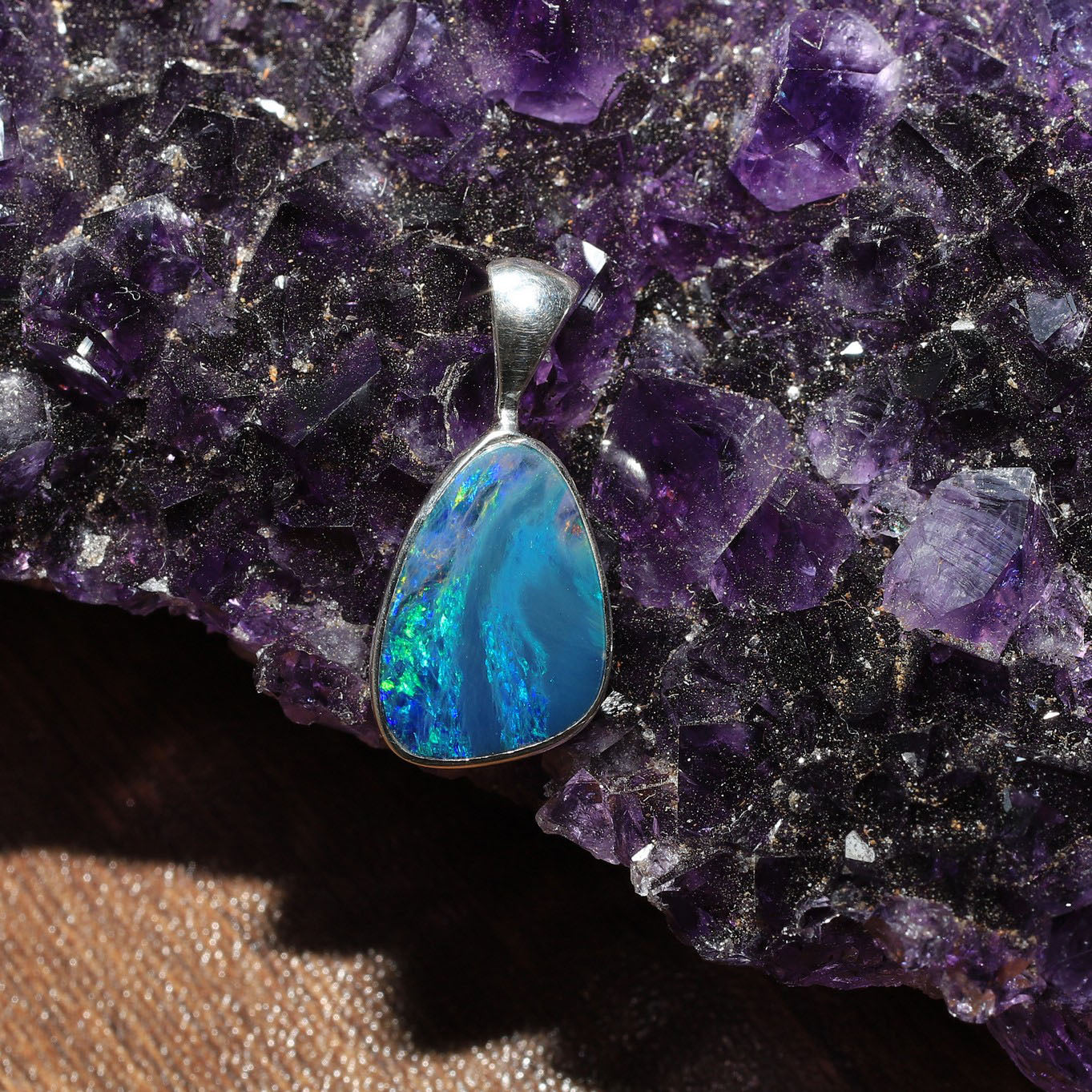

Larimar Gemstone: The Rare Caribbean Blue Stone and Its Wholesale Jewelry Value
Larimar Gemstone: The Rare Caribbean Blue Stone and Its Wholesale Jewelry Value
Complete larimar gemstone guide — geology, origin (Dominican Republic), quality grading, care, and why larimar in 925 sterling silver is a powerful wholesale ca
Larimar is a rare blue variety of pectolite (NaCa₂Si₃O₈(OH)) with a Mohs hardness of 4.5–5, found in only one place on Earth — a single volcanic mountain in the Barahona Province of the Dominican Republic — making it one of the rarest and most geographically exclusive gemstones in existence.
No other gemstone carries exclusivity quite like larimar. One country. One province. One mine area. The entire world's supply of larimar comes from a small volcanic intrusion in the mountains of the Dominican Republic's southwest coast. This singular origin story, combined with larimar's extraordinary blue patterns and spiritual resonance, makes it one of the most compelling wholesale jewelry categories in the world.


What Is Larimar? Geological Origins
Larimar is a blue variety of pectolite — a common mineral worldwide, but blue only in the Dominican Republic. The color comes from trace amounts of copper replacing calcium in the pectolite crystal structure. The same copper substitution that creates turquoise's blue is at work here, but in an entirely different mineral host, producing entirely different visual characteristics.
Chemical formula: NaCa₂Si₃O₈(OH) Crystal system: Triclinic Mohs hardness: 4.5–5 Specific gravity: 2.7–2.9 Luster: Waxy to silky Transparency: Opaque
Formation: Larimar forms within basaltic volcanic rocks through hydrothermal processes. Copper-rich hydrothermal fluids percolating through volcanic cavities interact with calcium silicate minerals to form the distinctive blue pectolite. The specific volcanic geology of the Barahona Province — and the presence of copper-bearing fluids in that geological context — doesn't exist anywhere else on Earth in the same configuration.
The Only Source in the World
Larimar is found exclusively in the Barahona Province of the Dominican Republic — specifically in the mountains near the town of Baoruco.
The "Los Chupaderos" mine area is the primary source. All larimar worldwide comes from within a few square kilometers of this location.
This geographical exclusivity has two significant commercial implications:
-
Authentic geographic storytelling: You can tell every buyer exactly where their stone came from — not just the country but the specific region, even the mountain. This level of provenance specificity is extraordinary in the gemstone market.
-
Supply sensitivity: Unlike broadly distributed gems (amethyst from dozens of countries), larimar's single-source supply means quality can vary with mining conditions and that very high-grade material is genuinely scarce.
Discovery and Naming
Larimar was formally discovered and documented in 1974 by Miguel Méndez and Peace Corps volunteer Norman Rilling, who found polished blue stones washing up on a beach near Barahona. Méndez named the stone by combining his daughter's name, Larissa, with the Spanish word for sea (mar) — "Larimar."
However, Dominican villagers had known about the blue stone in the mountains for generations, and it had been noted (but not geologically documented) by a Spanish priest in 1916.
Color Varieties and Quality Grading
Larimar's color ranges from white to light blue to deep sky blue to green-blue, always with characteristic cloud-like patterns, radiating inclusions, and the distinctive "Atlantis stone" visual texture:
| Quality | Color | Characteristics | Market |
|---|---|---|---|
| Volcanic Blue (AAA) | Deep sky blue; intense | Vivid, saturated; minimal white areas | Premium — most sought-after |
| Sky Blue (AA) | Medium blue | Good color; white cloud patterns | Commercial premium |
| Light Blue (A) | Pale blue to blue-gray | Lighter saturation; more white | Standard commercial |
| White-Blue | Predominantly white with blue | Minimal color; low value | Entry tier |
| Green-Blue | Blue with significant green | Less desirable; copper excess | Lower commercial tier |
The "waterscape" appearance: High-quality larimar has visual patterns that resemble waves, clouds, and sky seen from above — the blue and white swirls create an impression of tropical sea and sky that is unique to larimar. This is one of its most commercially appealing characteristics.
Larimar and Spiritual/Metaphysical Associations
Larimar has strong metaphysical market associations that significantly boost its retail storytelling potential:
- "The Atlantis Stone": Edgar Cayce's prophecies referenced a blue stone from a Caribbean "blue temple" — larimar enthusiasts identify it as the fulfillment of this prediction
- Sea and sky energy: Larimar is associated with calm, clarity, communication, and the soothing energy of tropical water
- "Dolphin Stone": Some metaphysical traditions associate larimar with dolphin energy and oceanic connection
- Throat chakra: In crystal healing traditions, larimar's blue color aligns it with the throat chakra — associated with communication and self-expression
For wholesale buyers serving markets with strong metaphysical and crystal healing interest — particularly in the USA, UK, Australia, and parts of Europe — larimar's rich metaphysical associations are a direct commercial asset.
Larimar in 925 Sterling Silver: Setting Considerations
Hardness concern: Larimar's Mohs 4.5–5 makes it softer than most commonly used gemstones. This has setting implications:
- Bezel settings are strongly recommended — the continuous metal wall of a bezel setting protects larimar's edges from impact damage
- Prong settings are acceptable for lower-wear pieces (pendants, earrings) but not ideal for rings worn daily
- Rings should be bezel-set — a larimar ring worn daily in a prong setting is at elevated risk of edge chipping
Surface care: Larimar's relatively soft surface is vulnerable to scratching. Recommend to retail customers that larimar rings be worn on fingers that don't encounter heavy manual work.
Larimar Care
| Factor | Recommendation |
|---|---|
| Cleaning | Wipe with soft damp cloth; brief warm soapy water is acceptable |
| Ultrasonic | Avoid — vibration risk |
| Steam | Avoid — heat sensitivity |
| Chemicals | Avoid all chemical exposure |
| Impact | Handle with care — softer than most gems |
| Storage | Store separately; can be scratched by harder gems |
| Water | Avoid prolonged submersion |
Why Larimar Is a Strong Wholesale Category
Exclusivity story: "This stone comes from one mountain in the Dominican Republic — the only place on Earth it exists." This is the most geographically specific origin story in jewelry. Customers remember it, repeat it, and attach identity to it.
Visual appeal: Larimar's sky-and-sea visual character is deeply appealing — it looks like tropical water, like the sky on a clear day, like calm. These associations trigger strong emotional purchase responses.
Instagram and social media performance: Larimar photographs beautifully against natural backgrounds (wood, sand, white marble). The blue-white patterns are highly photogenic and perform well in content across Instagram, TikTok, and Pinterest.
Coastal and travel market appeal: Larimar resonates strongly with buyers who love the ocean, travel, or the Caribbean. US coastal markets, Australian beach markets, and the broader "beach aesthetic" consumer demographic are natural audiences.


What is larimar and where does it come from?
Larimar is a rare blue variety of pectolite found exclusively in the Barahona Province of the Dominican Republic — the only place on Earth where this specific geological combination produces blue pectolite. Its blue color comes from trace copper content.
Why is larimar called the "Atlantis stone"?
Edgar Cayce's metaphysical writings referenced a blue stone from a Caribbean "blue temple" that would be rediscovered when Atlantis rose again. Larimar enthusiasts associate this prophecy with larimar's discovery in the Dominican Republic in 1974. The "Atlantis stone" designation is a marketing and metaphysical tradition, not a geological classification.
Is larimar a hard gemstone?
Larimar has a Mohs hardness of 4.5–5, which is relatively soft. This makes it less suitable for daily-wear rings than harder gemstones (quartz at 7, sapphire at 9), but appropriate for pendants, earrings, and bezel-set rings used with care.
How can I tell if larimar is real?
Genuine larimar has characteristic white "cloud" patterns within a blue matrix, a waxy luster, and the Mohs 4.5–5 hardness. Simulants (dyed blue glass, blue howlite) have different luster and pattern characteristics. Purchase from a reputable supplier with transparent sourcing — Natural Creations 925's in-house lapidary sources and processes authentic Dominican larimar.
What colors does larimar come in?
Larimar ranges from pale ice blue to vivid sky blue to blue-green, always with characteristic white cloud-like patterns. The most prized grade is "volcanic blue" — deep, saturated sky blue with striking white pattern contrast.
Open Your Wholesale Account Today
500+ artisans. In-house lapidary. 100% solar-powered. Same-day shipping on orders before 2 PM PST. Just your business license to get started.