
Labradorite Gemstone Guide: Labradorescence, Origins, and Wholesale Jewelry Market
Labradorite Gemstone Guide: Labradorescence, Origins, and Wholesale Jewelry Market
Complete labradorite gemstone guide — labradorescence explained, quality grading, care tips, and why labradorite in 925 sterling silver is a top wholesale categ
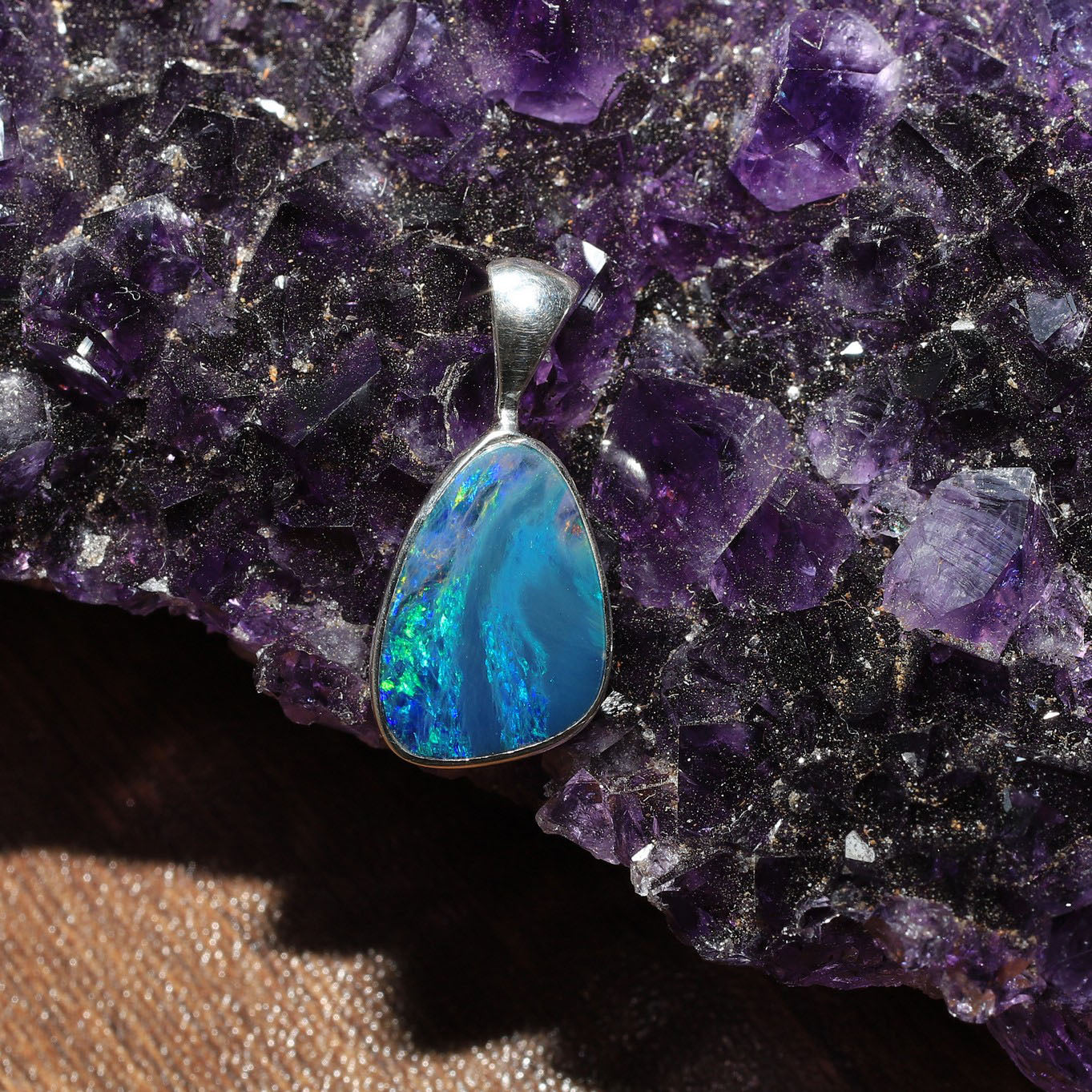
Labradorite is a calcium-rich plagioclase feldspar (Ca,Na)(Al,Si)₄O₈ with a Mohs hardness of 6–6.5, distinguished by labradorescence — a spectacular spectral color flash of electric blue, gold, green, and orange caused by light interference between microscopic alternating mineral layers within the stone.
Labradorite is the gemstone that most reliably stops people mid-sentence. The labradorescence — that sudden, unexpected flash of color when the stone catches light — is a genuine optical event. You move the stone and the colors appear from nowhere: electric blue, then shifting to gold, then blazing green. There is no other gem that surprises quite like labradorite.


What Is Labradorescence?
Labradorescence is the optical phenomenon specific to labradorite — a metallic iridescent play of spectral colors (typically electric blue, green, gold, yellow, and occasionally purple or orange) that appears when light strikes the stone from the right angle.
The mechanism is interference — the same physics that creates the rainbow colors in soap bubbles and oil films on water:
- Light enters the labradorite and encounters microscopic alternating layers of calcium-rich and sodium-rich feldspar (exsolution lamellae)
- Light reflects from the top and bottom surfaces of each thin layer
- These reflected light waves interfere with each other — some wavelengths reinforce (appear as vivid color) while others cancel out
- The specific colors depend on the thickness of the alternating layers and the angle of observation
The result: a stone that appears dull or gray from one angle but blazes with pure spectral color from another. This is not surface reflection (like metallic luster) — the color comes from within the stone's structure.
Comparison with moonstone's adularescence: Both are feldspar phenomena caused by alternating mineral layers. Adularescence (moonstone) produces a diffuse, floating glow. Labradorescence produces a more directional, metallic color flash — the colors appear and disappear dramatically as the viewing angle changes.
Chemical Properties and Formation
Chemical formula: (Ca,Na)(Al,Si)₄O₈ (calcium-sodium aluminum silicate — intermediate composition between anorthite and albite) Crystal system: Triclinic Mohs hardness: 6–6.5 Specific gravity: 2.69–2.72 Refractive index: 1.560–1.568 Luster: Vitreous to pearly on cleavage faces Transparency: Translucent to opaque
Discovery and the Labrador Connection
Labradorite takes its name from the Labrador Peninsula of Canada — specifically from Paul's Island, Labrador, where it was first described to Western science in 1770 by Moravian missionaries who encountered it there.
However, the Inuit people of the region had used the stone for centuries and had their own origin legend: that the Northern Lights (Aurora Borealis) had fallen from the sky into the rocks, and that a warrior had struck the rocks with his spear to release most of the light back to the sky — but some remained trapped in the stone. This legend resonates with the aurora-like color display of the labradorescence.
Major Sources
| Source | Characteristics | Market Notes |
|---|---|---|
| Madagascar | Finest commercial quality; spectacular blue-to-gold flash; large deposits | Dominant commercial source; most wholesale jewelry |
| Finland (Spectrolite) | Intense full-spectrum labradorescence; deep black background; "spectrolite" trade name | Premium collector grade; spectacular |
| Canada (Labrador) | Historical discovery location; generally moderate labradorescence | Collector/heritage interest |
| USA (Oregon Sunstone) | A closely related labradorite variety with different characteristics | Specialty market |
| Russia, Ukraine, China | Commercial production | Variable quality |
Natural Creations 925 sources labradorite rough primarily from Madagascar — the source that consistently delivers the vivid blue-and-gold labradorescence that makes their wholesale jewelry pieces so visually compelling.
Quality Grading
| Grade | Labradorescence Characteristics | Market Value |
|---|---|---|
| AAA | Full-coverage vivid blue + gold + green flash; appears from multiple angles | Premium |
| AA | Strong blue flash covering most of stone face | Commercial premium |
| A | Moderate flash; visible from specific angles only | Standard commercial |
| AB | Weak or partial flash; gray/dull from most angles | Entry tier |
| Spectrolite (Finnish) | Full rainbow spectrum: blue, green, gold, yellow, purple, orange | Collector premium |
Coverage: The percentage of the stone face showing labradorescence matters enormously. A stone with 100% flash coverage (which appears colorful from virtually any angle) commands a significant premium over a stone where the flash is visible only from a narrow angle.
Flash color: Blue is the most desired single color. Full-spectrum stones (showing multiple colors across the surface) are the most spectacular and command highest value.
The "Rainbow Moonstone" Confusion
Many stones sold commercially as "rainbow moonstone" are actually a variety of labradorite — specifically semi-transparent labradorite with a strong blue adularescence-like glow. This causes genuine market confusion:
| Stone | Mineral | Optical Phenomenon |
|---|---|---|
| True moonstone | Orthoclase feldspar | Adularescence (diffuse glow) |
| Labradorite | Plagioclase feldspar | Labradorescence (directional flash) |
| "Rainbow moonstone" | Often labradorite | Blue adularescence/labradorescence |
Both are beautiful. Both are feldspar. But they are different minerals with different optical mechanisms. Accurate labeling: "labradorite" or "rainbow labradorite" is technically more precise than "rainbow moonstone" for the common commercial material. Natural Creations 925 categorizes these accurately.
Labradorite in 925 Sterling Silver: Setting Considerations
Bezel settings are the most common and most effective for labradorite:
- Protects the stone's edges (Mohs 6–6.5; cleavage-prone)
- The metal frame focuses attention on the stone's face — where labradorescence appears
- Works beautifully in both oxidized and bright silver settings
Oxidized silver + labradorite: This is one of the most visually dramatic pairings in silver jewelry. The dark patina of oxidized silver creates a high-contrast background that makes the electric blue flash appear even more vivid. This combination photographs extremely well.
Stone orientation in setting: The lapidary must orient labradorite correctly within the cabochon to ensure the labradorescence displays from the top face (not from the side or bottom). In-house lapidary expertise — as practiced by Natural Creations 925 — ensures this orientation is correct in every stone.
Labradorite on Social Media: A Natural Content Phenomenon
Labradorite is, without question, one of the top-performing gemstones for social media content:
- Videos of labradorite moving under a ring light consistently go viral on TikTok and Instagram Reels — the color flash appears and disappears in a way that's genuinely mesmerizing on video
- The explanation is shareable: "The color you see in this stone is called labradorescence — it happens because light is interfering between microscopic layers inside the crystal" is the kind of fact people want to share
- The Inuit origin legend is one of the most compelling gemstone stories in existence — "the Northern Lights trapped inside a stone" is remarkable storytelling
For Instagram live sellers, labradorite pieces often produce the highest claim rates per piece of any gemstone category.
Labradorite Care
| Factor | Recommendation |
|---|---|
| Cleaning | Warm soapy water, soft brush |
| Ultrasonic | Avoid — cleavage vulnerability |
| Steam | Avoid |
| Impact | Moderate care; cleavage present |
| Storage | Padded, separate from harder gems |


What is labradorescence?
Labradorescence is the spectacular optical color phenomenon of labradorite — a shifting spectral flash of electric blue, gold, green, and other colors caused by light interference between microscopic alternating mineral layers within the stone. The colors appear and disappear dramatically as the viewing angle changes.
Where does labradorite come from?
Labradorite is found primarily in Madagascar (the dominant commercial source), Finland (premium "spectrolite" grade), Canada (original discovery location), and Russia/Ukraine. Natural Creations 925 sources labradorite rough primarily from Madagascar for their in-house lapidary processing.
What is the difference between labradorite and moonstone?
Both are feldspar minerals with optical phenomena, but they are different minerals. Moonstone (orthoclase) produces adularescence — a diffuse, floating glow. Labradorite (plagioclase) produces labradorescence — a directional, metallic color flash. Many commercial stones sold as "rainbow moonstone" are actually semi-transparent labradorite.
Why does labradorite show different colors?
Labradorite's color flash (labradorescence) is caused by light interference — the same physics that creates rainbow colors in soap bubbles. Light entering the stone reflects from microscopic alternating mineral layers; different wavelengths (colors) reinforce or cancel depending on layer thickness and viewing angle, creating the spectral color display.
Is labradorite a birthstone?
Labradorite has no traditional birthstone designation, but it is strongly associated with February/Aquarius and the broader crystal healing tradition. Its spectacular visual character makes it a compelling choice for any buyer, regardless of birth month.
Open Your Wholesale Account Today
500+ artisans. In-house lapidary. 100% solar-powered. Same-day shipping on orders before 2 PM PST. Just your business license to get started.