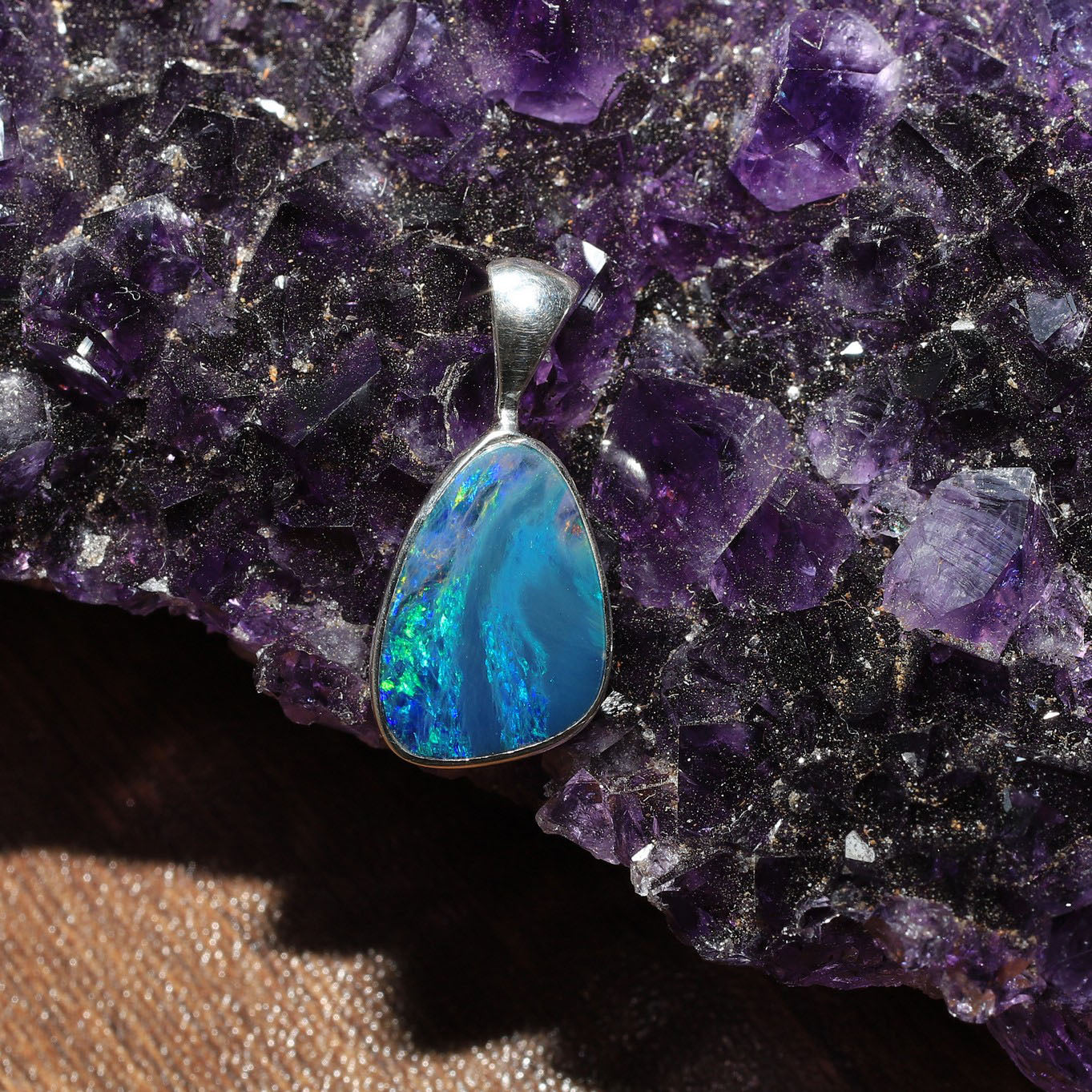

Kyanite Gemstone Wholesale Guide: The Self-Cleansing Blue Crystal
Kyanite Gemstone Wholesale Guide: The Self-Cleansing Blue Crystal
Source kyanite gemstone jewelry wholesale — covering aluminum silicate mineralogy, directional hardness, healing properties, Throat and Third Eye chakra connect
Kyanite gemstone jewelry wholesale is one of the most distinctive and metaphysically powerful categories in the sterling silver market — a striking blue aluminum silicate with a unique property found in almost no other gemstone: directional hardness that varies dramatically depending on which axis you measure. This guide covers kyanite's unusual mineralogy, quality grading, healing properties, sourcing, wholesale strategy, and care considerations every buyer needs to build a profitable kyanite collection.


What Is Kyanite?
Kyanite is an aluminum silicate mineral (Al₂SiO₅) that forms in metamorphic rocks under high pressure. Its name comes from the Greek "kyanos," meaning deep blue — though kyanite also occurs in green, orange, and black varieties. What makes kyanite mineralogically unique is its extreme directional hardness, technically called anisotropy: the stone measures Mohs 4.5 along its length (parallel to the crystal blade) but Mohs 6.5–7 across its width (perpendicular to the blade). No other common gemstone displays such a dramatic difference in hardness depending on direction.
This blade-like crystal habit — long, flat, columnar crystals with a pearly-to-vitreous luster — gives kyanite jewelry a distinctly architectural, modern aesthetic that stands apart from rounder, more conventional gemstones.
Key Mineral Profile
| Property | Detail |
|---|---|
| Mineral Family | Aluminum silicate (nesosilicate) |
| Chemical Composition | Al₂SiO₅ |
| Color | Blue (most common), green, orange, black, grey |
| Mohs Hardness | 4.5–5 (parallel to blade) / 6.5–7 (perpendicular to blade) |
| Crystal System | Triclinic |
| Luster | Vitreous to pearly |
| Transparency | Transparent to translucent |
| Specific Gravity | 3.53–3.67 |
| Refractive Index | 1.710–1.734 |
| Cleavage | Perfect in one direction |
The directional hardness is the single most important fact for wholesale buyers to understand. When kyanite is cut and set properly — with the harder axis facing outward and the softer axis protected by the setting — it performs well in earrings, pendants, and carefully designed rings. Cutting expertise matters enormously. Suppliers with in-house lapidary teams who understand kyanite's anisotropy produce dramatically more durable finished stones than those who treat it like standard material.
What Are the Different Varieties of Kyanite?
While blue kyanite dominates the jewelry market, several color varieties offer distinct opportunities for wholesale buyers seeking differentiation.
Kyanite Variety Guide
| Variety | Color | Visual Character | Market Demand | Wholesale Positioning |
|---|---|---|---|---|
| Blue Kyanite (Classic) | Medium to deep blue, often with lighter and darker zones | Blade-like crystals with satiny blue tones reminiscent of sapphire | Highest — this is the signature kyanite look | Core inventory; must-stock |
| Cornflower Blue Kyanite | Vivid medium-blue with excellent saturation | The most prized color; comparable to fine sapphire hue | Very high — premium demand | Top-tier hero pieces |
| Green Kyanite | Medium to deep green | Forest-toned with similar blade structure to blue | Growing — appeals to emerald-alternative buyers | Specialty; unique collection pieces |
| Orange Kyanite | Warm orange to amber | Unusual and eye-catching; very limited supply | Moderate — collector and crystal market | Rare; premium pricing justified |
| Black Kyanite | Deep black with fan-like crystal formations | Dramatic, grounding aesthetic | Moderate — metaphysical market, men's jewelry | Protection-themed and men's lines |
Sourcing advantage: Retailers who can offer blue kyanite alongside green or black varieties capture both the mainstream jewelry buyer and the crystal collector. Natural Creations 925 sources kyanite rough globally and processes it through their in-house lapidary at their 60,000 sq ft factory, where cutters trained specifically in anisotropic materials orient each stone for maximum hardness exposure and visual impact.
Where Does Kyanite Come From?
Brazil produces the largest volume of gem-quality kyanite, but significant deposits in Nepal and other regions offer distinct quality characteristics.
Source Comparison Table
| Origin | Output Volume | Quality Profile | Varieties Available | Market Position |
|---|---|---|---|---|
| Brazil (Minas Gerais) | High — primary global source | Excellent transparency and saturation; large crystals available | Blue (primary), green | Industry standard; best all-around source |
| Nepal (Kali Gandaki region) | Moderate | Exceptional color — some of the finest deep blue kyanite in the world | Blue | Premium source; "Himalayan kyanite" commands higher prices |
| South Asia | Moderate to high | Good quality; wide range of grades | Blue, green, orange (rare) | Major cutting center; supplies both rough and finished |
| Kenya | Low to moderate | Good medium-blue; smaller crystals | Blue | Growing source; consistent quality |
| Tanzania | Low to moderate | Good quality; occasionally vivid blue | Blue | Supplementary source |
| Myanmar | Low | Variable; some fine specimens | Blue | Minor source |
| USA (North Carolina, Connecticut) | Low | Collector-grade; limited gem quality | Blue, green, black | Niche; domestic-sourced marketing angle |
Nepalese kyanite from the Himalayan region is widely regarded as producing the deepest, most saturated blues — comparable to fine Ceylon sapphire in hue. For wholesale buyers seeking a premium positioning, specifying Nepalese or Brazilian origin adds value and story to the product listing.
How Is Kyanite Quality Graded?
Kyanite grading centers on color saturation, transparency, and the absence of visible inclusions. Because kyanite's blade-like crystal habit makes clean, transparent specimens relatively rare in larger sizes, quality drops off more steeply with size than in most gemstones.
Wholesale Grading Guide
| Grade | Color | Transparency | Inclusions | Cut Quality | Wholesale Use |
|---|---|---|---|---|---|
| AAA (Premium) | Deep, saturated blue; even color throughout | Transparent — light passes through cleanly | Eye-clean; no visible inclusions | Excellent orientation for maximum hardness | Hero pieces, high-end retail, sapphire-alternative positioning |
| AA (Fine) | Strong medium blue; minor color zoning | Good transparency | Minimal visible inclusions | Good orientation | Core collection; reliable quality |
| A (Standard) | Medium blue; some lighter or darker zones | Semi-transparent to translucent | Some visible inclusions acceptable | Adequate orientation | Volume inventory; everyday price points |
| B (Commercial) | Lighter blue or uneven color | Translucent to semi-opaque | Visible inclusions | Basic cut | Entry price points; metaphysical market |
Critical grading note for kyanite: Cut orientation is arguably as important as any other quality factor. A well-oriented kyanite stone — cut perpendicular to the blade so the harder axis faces outward — will perform dramatically better in jewelry than a poorly oriented one, regardless of color grade. This is why sourcing from a supplier with experienced lapidary cutters makes a material difference for kyanite specifically.
What Are Kyanite's Healing Properties and Metaphysical Associations?
Kyanite holds a unique position in crystal healing: it is one of very few stones believed to never accumulate negative energy — meaning it never needs cleansing or recharging. This self-cleansing property alone makes kyanite one of the most commercially appealing gemstones in the metaphysical market.
Healing Properties Overview
| Property | Traditional Association | Customer Appeal |
|---|---|---|
| Self-Cleansing | Believed to never absorb or hold negative energy; never needs cleansing | Extremely marketable — eliminates maintenance; perfect for beginners |
| Communication | Associated with clear, honest expression and speaking truth | Strong narrative for public speakers, teachers, communicators |
| Alignment | Believed to instantly align all chakras simultaneously | Powerful positioning for energy workers and healers |
| Calming & Meditation | Linked to deep meditation states and tranquility | Wellness and mindfulness market crossover |
| Bridging Gaps | Said to repair damaged relationships and restore trust | Emotional healing market; relationship-themed jewelry |
Chakra Connections
Kyanite is primarily associated with two chakras:
Throat Chakra (Vishuddha): Blue kyanite resonates strongly with the Throat Chakra, the energy center governing communication, self-expression, and speaking truth. In crystal healing practice, wearing blue kyanite near the throat is believed to clear communication blocks, encourage honest dialogue, and support confident self-expression.
Third Eye Chakra (Ajna): Kyanite's secondary association is with the Third Eye Chakra, the center of intuition, perception, and inner wisdom. Deeper blue specimens are particularly linked to enhanced intuition, lucid dreaming, and meditation depth.
Unique property: Kyanite is said to align all seven chakras simultaneously — not just the Throat and Third Eye. This "universal alignment" attribute makes it one of the most versatile stones in a chakra-themed collection.
Zodiac Associations
Kyanite is traditionally linked to Aries (March 21 – April 19) and Taurus (April 20 – May 20). Aries is said to benefit from kyanite's calming, balancing energy as a counterweight to fire-sign intensity, while Taurus connects with its grounding stability and communication support. Retailers who position kyanite as an Aries/Taurus stone during spring zodiac season see measurable sales lifts.
How Should Wholesale Buyers Build a Kyanite Collection?
Kyanite's distinctive blue color, self-cleansing reputation, and dual-chakra resonance make it a versatile wholesale stone — but its directional hardness requires thoughtful jewelry format selection.
Collection Strategy by Market Segment
| Segment | Best Formats | Best Varieties | Typical Wholesale Price Range | Why It Works |
|---|---|---|---|---|
| Women's Statement | Dangle earrings, pendant necklaces, cocktail rings (protective settings) | Cornflower blue, classic blue | $25–$65 | Sapphire-blue beauty at a fraction of sapphire price |
| Everyday Wear | Stud earrings, small pendants, bezel-set rings | Classic blue, green | $18–$40 | Protected settings keep the softer axis safe |
| Wellness & Crystal | Intention necklaces, self-cleansing sets, alignment jewelry | Blue (primary), black | $15–$45 | Self-cleansing story is the ultimate selling point |
| Meditation & Yoga | Mala-inspired necklaces, Third Eye pendants, meditation rings | Blue, green | $20–$50 | Deep meditation and alignment associations |
| Men's & Unisex | Simple pendants, beaded bracelets, signet-style rings | Black kyanite, deep blue | $20–$45 | Architectural blade aesthetic reads modern and masculine |
Setting recommendation: Because of kyanite's directional hardness, bezel settings and protective designs outperform prong settings for rings and bracelets. Earrings and pendants — which experience less direct contact and impact — can use prong settings safely. Educating retail customers on this distinction builds trust and reduces returns.
Customization advantage: Kyanite's anisotropy demands skilled cutting, which means custom pieces from expert manufacturers dramatically outperform generic stock. Natural Creations 925 offers two custom programs — "Curated for You" (their team selects and creates kyanite pieces designed for your market) and "Designed by You" (you provide your vision and their 500+ artisans, 75% of whom are women, bring it to life using German precision machinery at their solar-powered factory). Custom kyanite jewelry with proper orientation and protective settings becomes inventory your competitors simply cannot match.
How Does Kyanite Compare to Other Blue Gemstones?
Blue gemstones are among the most commercially important in the wholesale market. Understanding where kyanite fits against alternatives helps buyers position it effectively.
Competitive Comparison Table
| Factor | Kyanite | Blue Sapphire | Blue Topaz | Lapis Lazuli | Tanzanite |
|---|---|---|---|---|---|
| Color | Medium to deep blue | Deep blue | Light to deep blue | Deep blue with gold flecks | Violet-blue |
| Hardness (Mohs) | 4.5–7 (directional) | 9 | 8 | 5–6 | 6–7 |
| Price Point | Affordable | Very expensive | Affordable | Moderate | Expensive |
| Translucency | Transparent to translucent | Transparent | Transparent | Opaque | Transparent |
| Metaphysical Appeal | Very strong (self-cleansing, alignment) | Moderate | Moderate | Strong | Strong |
| Daily Wear Suitability | Good (with proper setting) | Excellent | Excellent | Fair | Good |
| Wholesale Availability | Good; consistent supply | Limited at quality levels | Abundant | Good | Limited |
Kyanite wins when customers want sapphire-level blue beauty with powerful metaphysical properties at an accessible price point. The self-cleansing attribute alone differentiates it from every other blue gemstone in the market.
What Care Does Kyanite Jewelry Require?
Kyanite's directional hardness means care guidance is more important than for most gemstones — and providing clear instructions builds retailer credibility and reduces returns.
Care Guide
| Do | Don't |
|---|---|
| Clean gently with warm soapy water and a soft cloth | Avoid ultrasonic cleaners (can exploit cleavage planes) |
| Store in a soft pouch or lined box, separated from harder stones | Do not store loose with sapphires, topaz, or diamonds |
| Wear earrings and pendants confidently for daily use | Avoid wearing kyanite rings during heavy manual work |
| Handle gently along the blade direction (softer axis) | Do not use steam cleaners |
| Choose bezel-set or protective-setting rings | Avoid prong-set rings for heavy daily wear |
Retailer tip: Including a brief care card with kyanite jewelry that explains the directional hardness in simple terms — "this stone is harder side-to-side than lengthwise, so avoid sharp impacts along the length" — transforms a potential concern into a conversation starter. Customers who understand their stone's unique properties feel more connected to it and value it more.


Does kyanite really never need cleansing?
In crystal healing traditions, kyanite is one of very few stones believed to never accumulate or retain negative energy, meaning it does not require energetic cleansing the way most crystals do. This is one of kyanite's most commercially powerful attributes — customers new to crystals particularly appreciate a stone that is "maintenance-free" from a metaphysical perspective. While this is a metaphysical claim rather than a scientific one, it is universally consistent across crystal healing literature.
Is kyanite too soft for jewelry?
No — but it requires informed design. Kyanite's hardness ranges from 4.5 to 7 depending on direction. When cut and set properly (with the harder axis facing outward and protective settings used for rings and bracelets), kyanite performs well in everyday jewelry. Earrings and pendants are especially well-suited because they experience minimal direct impact. The key is sourcing from manufacturers who understand kyanite's anisotropy and cut accordingly.
Is kyanite more affordable than sapphire?
Significantly. Kyanite offers comparable blue beauty — particularly in cornflower blue grades — at a fraction of sapphire's price. A fine AAA kyanite in sterling silver wholesale will cost dramatically less than even a commercial-grade blue sapphire. For retailers whose customers want beautiful blue gemstone jewelry without the sapphire price tag, kyanite is one of the strongest alternatives available.
What is the difference between blue kyanite and green kyanite?
Blue and green kyanite are the same mineral (aluminum silicate) with different trace element compositions creating the color difference. Blue kyanite gets its color from iron and titanium, while green kyanite's color comes from chromium or vanadium. Both share the same directional hardness and crystal structure. In metaphysical traditions, blue kyanite is associated with communication and the Throat Chakra, while green kyanite is linked to the Heart Chakra and emotional balance. Both are said to share the self-cleansing property.
Can kyanite be used in engagement rings?
Kyanite can work in engagement ring designs with careful setting choices. A bezel setting or halo design that protects the stone from side impacts is essential. Kyanite engagement rings appeal to buyers who want a unique, meaningful blue stone with deep metaphysical significance — particularly the self-cleansing and alignment properties. However, for high-activity wearers, recommending earrings or a pendant as the primary kyanite piece alongside a harder-stone ring is a responsible approach that builds long-term trust.


Open Your Wholesale Account Today
500+ artisans. In-house lapidary. 100% solar-powered. Same-day shipping on orders before 2 PM PST. Just your business license to get started.